
What are contact lenses?
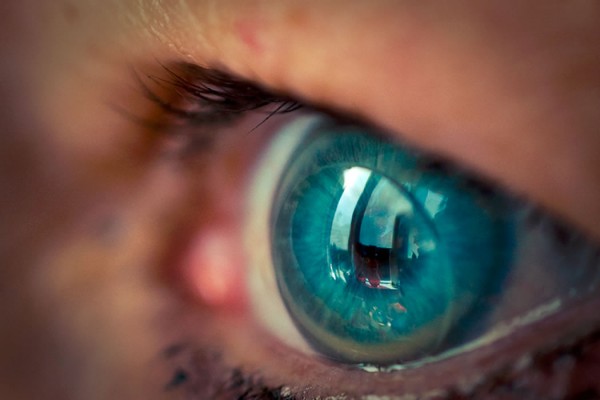
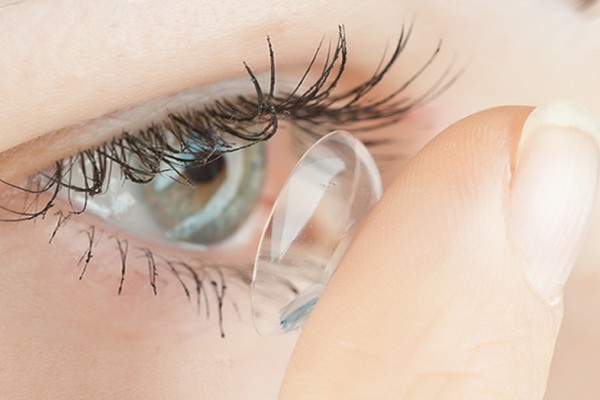
Contact lenses are very small, curved discs that users can place directly onto the surface of their eyes to correct their vision. They are usually made of soft, pliable plastic called hydrogel.
Hydrogel absorbs and retains water, making it flexible enough to comfortably sit on the cornea (the front surface of the eye). This water retention also allows oxygen to pass through the contact lens so it can nourish and hydrate the cornea.
While most people rely on contact lenses for vision correction, they can also be worn for cosmetic reasons. For example, coloured contacts give your eyes the appearance of being a different colour, and may or may not include vision correction. Special effects contacts are often used with costumes — think movie sets and Halloween — to give the eyes unnatural characteristics.
How do contacts work?
Similar to eyeglasses, single-vision contact lenses work by bending light to correct refractive errors. A refractive error is a type of vision problem that occurs when irregularities in the eye affect how light is focused. When light does not focus properly on the retina at the back of the eye, blurry vision may result.
The following refractive errors can often be corrected with prescription contact lenses:
- Myopia (nearsightedness) – Affects distance vision
- Hyperopia (farsightedness) – Affects near vision and sometimes distance vision
- Astigmatism – Affects distance and near vision
- Presbyopia – Affects near vision due to age-related changes to the eye’s lens
Contact lenses correct refractive errors by bending light before it enters the eyes. This allows light to focus correctly on the retina, the light-sensitive tissue at the back of the eye.
If you have presbyopia and need vision correction at more than one distance, your eye doctor may recommend that you try multifocal contact lenses. Multifocal lenses such as progressive and bifocal contacts work by correcting vision at multiple distances.
Types of contact lenses
The different types of contact lenses are categorized by the materials they’re made with and the purpose they serve. Below are some of the most common types of contacts that an eye doctor may prescribe:
- Soft contact lenses – Made of soft, flexible plastics that are generally more comfortable to wear than other types
- Rigid gas permeable (RGP) contact lenses – Made of a firm, durable plastic; often prescribed for severe astigmatism or irregular corneas
- Hybrid contact lenses – Have a rigid centre surrounded by a soft outer ring, combining the visual clarity of RGP lenses and the comfort of soft contacts
- Toric contact lenses – A type of soft contact lenses prescribed for astigmatism
- Scleral contact lenses – Have a large diameter that covers the entire corneal surface and rests on the sclera (the white part of the eye)
- Orthokeratology (Ortho-K) lenses – Specially designed hard contact lenses that are worn overnight to temporarily reshape the cornea; used mainly to correct myopia
- Daily wear contact lenses – Designed to be worn all day then removed at night before bed for storage or disposal (this is determined by the recommended replacement schedule)
- Extended-wear contacts – Made to be worn continuously for up to 30 days
How are contact lenses made?
Different methods are used to ensure your contact lenses fit perfectly against your eyes. These techniques include:
Injection moulding
This creation method is used for soft contact lenses. It involves injecting molten plastic into a mould and then putting it under pressure to form the lens. The mould has two parts that have different curvature for different lens prescriptions.
After the plastic is shaped with the moulds, it’s cured in an oven, then packaged and hydrated in water to create lens flexibility. From there, contact solution is added to the sterilized contact lens container, then heat-sealed with a foil cover.
Lathe cutting
While this method is also used for soft lenses, it’s most often used for rigid lenses. For context, lathe cutting is like creating an ice sculpture, where a block of material is carved into a desired shape.
Rather than a block of ice, a non-hydrated disc of contact lens material is mounted on a machine. The machine then spins the material quickly — about 100 rotations per second — while a laser cutter makes precise, digitally measured cuts into the lens material.
Once the front and back of the lens are shaped by the laser cutter, the lens is polished and hydrated. RGP lenses are made following this same meticulous process, but they are delivered to the eye doctor dry. The eye doctor will then soak the lenses before giving them to the patient.
The history of contact lenses
Contact lenses weren’t conceptualized or perfected right away. The idea for them started in the early 1500s and slowly developed over time. Check out the general timeline below to see how contact lenses have evolved throughout the years:
1508 – Leonardo da Vinci shares the first concept of contact lenses.
1887 – The first contact lens is manufactured, made of glass and covering the whole eye.
1939 – The first plastic contact lenses are made — and they still cover the entire eye.
1948 – Plastic contact lenses are remade to cover only the cornea rather than the whole eye.
1971 – Soft contact lenses are invented.
1978 – Gas permeable lenses are created.
1981 – Extended-wear soft contacts become available.
1982 – Bifocal soft contact lenses are invented.
1986 – Gas permeable lenses are approved for overnight wear.
1996 – Daily disposable soft contact lenses are introduced.
2002 – Orthokeratology lenses are approved by the U.S. Food and Drug Administration (FDA) to be worn overnight.
2010 – Custom-manufactured silicone-hydrogel lenses become available.
2018 – Photochromic (light-adaptive) contact lenses are approved by the FDA.
Schedule a contact lens exam fitting to learn more
Whether you’re interested in contacts to correct your vision or to give your eyes an interesting new look, your eye doctor can help.
They can perform an eye exam to check your vision and eye health, then do a contact lens fitting to determine your contact lens prescription. (It’s different from your glasses prescription.) This ensures you get the best type of contacts for your needs and minimizes the risk of any complications.
Book an eye exam to get a new contact lens prescription or to update your old one.
SOURCES
- What are contacts made of? All About Vision. January 2019.
- Contacts. Cleveland Clinic. July 2023.
- Refractive errors. National Eye Institute. November 2023.
- Should you get bifocal contact lenses? GoodRx Health. August 2021.
- Gas permeable contact lenses (RGP or GP). Vision Center. February 2024.
- Hybrid contact lenses and your eyes. Verywell Health. October 2022.
- Contact lenses for astigmatism. All About Vision. February 2019.
- What is orthokeratology? EyeSmart. American Academy of Ophthalmology. April 2023.
- How are contact lenses made? Discovery UK. June 2022.
- How are contact lenses made? All About Vision. January 2019.
- When were contact lenses invented? All About Vision. January 2019.
- FDA clears first contact lens with light-adaptive technology. U.S. Food and Drug Administration. April 2018.